
On-Grid vs Off-Grid vs Hybrid Solar: Which Solar System Is Right for You?
Installing a rooftop solar system is one of the smartest investments you can make—but choosing the right type of solar system is just as important.
Many homeowners ask:
- What is an On-Grid Solar System?
- What is an Off-Grid Solar System?
- What is a Hybrid Solar System?
- Which one is best for my home?
In this guide, we’ll explain all three systems in simple terms so you can choose the one that best suits your energy needs.
What Are the Main Types of Solar Systems?
There are three primary types of solar systems:
- On-Grid Solar System
- Off-Grid Solar System
- Hybrid Solar System
Each system has its own advantages and is designed for different requirements.
1. On-Grid Solar System
An On-Grid Solar System is connected to your local electricity grid.
It generates electricity during the day, powers your home first, and sends any extra electricity back to the grid through Net Metering.
At night or when solar production is low, your home automatically uses electricity from the utility grid.
How It Works
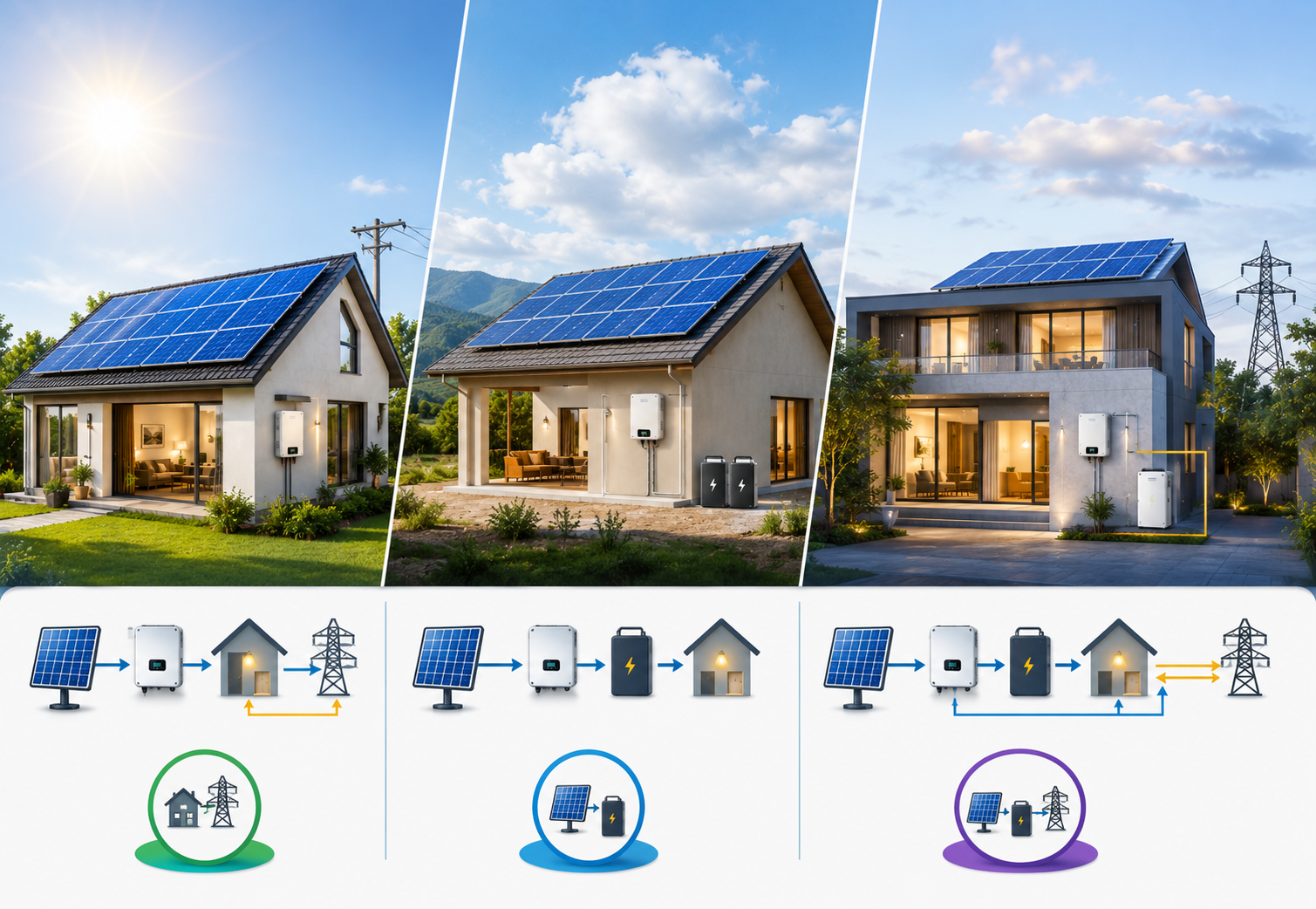
☀️ Solar Panels → ⚡ Solar Inverter → 🏠 Home → 🔌 Electricity Grid
Advantages of On-Grid Solar
✔ Lowest installation cost
✔ No battery required
✔ Net Metering reduces electricity bills
✔ Low maintenance
✔ High return on investment (ROI)
✔ Ideal for urban homes and businesses
Limitations
- Does not provide backup during power cuts (unless combined with battery backup).
- Requires an active grid connection.
Best For
- Homes in cities
- Offices
- Schools
- Shops
- Commercial buildings
2. Off-Grid Solar System
An Off-Grid Solar System works completely independently of the electricity grid.
It stores excess electricity in batteries so you can use power at night or during cloudy weather.
This system is commonly installed in locations where grid electricity is unavailable or unreliable.
How It Works
☀️ Solar Panels → 🔋 Battery → ⚡ Inverter → 🏠 Home
Advantages of Off-Grid Solar
✔ Complete energy independence
✔ Works even where there is no electricity connection
✔ Ideal for remote locations
✔ Battery backup available 24/7
Limitations
- Higher installation cost due to batteries
- Batteries require maintenance and eventual replacement
- More space is needed for battery storage
Best For
- Farmhouses
- Villages
- Remote areas
- Mountain regions
- Construction sites
3. Hybrid Solar System
A Hybrid Solar System combines the benefits of both On-Grid and Off-Grid systems.
It is connected to the electricity grid while also using batteries for backup power.
During the day:
- Solar powers your home.
- Extra electricity charges the batteries.
- Remaining surplus can be exported to the grid.
During a power cut:
The battery automatically supplies electricity to essential appliances.
How It Works
☀️ Solar Panels → ⚡ Inverter → 🏠 Home
⬇
🔋 Battery Backup
⬇
🔌 Electricity Grid
Advantages of Hybrid Solar
✔ Backup during power cuts
✔ Lower electricity bills
✔ Battery storage
✔ Net Metering benefits
✔ Greater energy independence
✔ Ideal for areas with frequent power outages
Limitations
- Higher initial investment
- Battery replacement after several years
- Slightly more complex installation
Best For
- Homes with frequent power cuts
- Hospitals
- Clinics
- Small businesses
- Luxury villas
Quick Comparison
| Feature | On-Grid | Off-Grid | Hybrid |
|---|---|---|---|
| Grid Connection | ✔ Yes | ❌ No | ✔ Yes |
| Battery Required | ❌ No | ✔ Yes | ✔ Yes |
| Backup During Power Cut | ❌ No | ✔ Yes | ✔ Yes |
| Net Metering | ✔ Yes | ❌ No | ✔ Yes |
| Installation Cost | Low | High | Medium to High |
| Maintenance | Low | Medium | Medium |
| Electricity Bill Savings | High | High | High |
| Suitable for Cities | ✔ Excellent | ❌ Limited | ✔ Excellent |
| Suitable for Remote Areas | ❌ No | ✔ Yes | Limited |
Which Solar System Is Best?
Choose On-Grid If:
- You have a reliable electricity supply.
- You want maximum savings.
- You don’t need battery backup.
- You want the fastest return on investment.
Choose Off-Grid If:
- You don’t have access to grid electricity.
- You want complete energy independence.
- Your property is in a remote location.
Choose Hybrid If:
- Your area experiences frequent power cuts.
- You want both electricity savings and backup power.
- You are looking for long-term energy security.
Cost Comparison
The cost depends on system size, equipment quality, and installation requirements.
Generally:
- On-Grid: Most affordable option
- Off-Grid: Highest cost due to battery storage
- Hybrid: Moderate to high cost because it includes both grid connectivity and batteries
Although Hybrid and Off-Grid systems require a higher initial investment, they provide greater energy security and backup during outages.
Which System Saves More Money?
If your primary goal is to reduce electricity bills, an On-Grid Solar System is usually the most cost-effective option.
Thanks to Net Metering, excess electricity generated during the day is exported to the grid, helping reduce your monthly electricity bill.
Government Subsidy
Residential homeowners may be eligible for financial assistance under the PM Surya Ghar: Muft Bijli Yojana, subject to the latest government guidelines and eligibility criteria.
An authorized installer can assist with the subsidy application process.
Why Choose Tata Power SolarRoof?
When investing in solar, choosing a trusted brand is essential.
With Tata Power SolarRoof, you receive:
- High-efficiency solar panels
- Reliable performance in all weather conditions
- Professional installation
- Durable mounting structures
- Advanced inverter technology
- Excellent after-sales support
Why Choose KG Insolation Pvt. Ltd.?
KG Insolation Pvt. Ltd. is an Authorized Tata Power SolarRoof Channel Partner, providing complete rooftop solar solutions for residential, commercial, industrial, educational, and institutional customers.
Our services include:
- Free Site Survey
- Customized Solar System Design
- Residential & Commercial Installations
- Government Subsidy Assistance
- Net Metering Support
- Professional Installation
- Maintenance & After-Sales Service
Whether you need an On-Grid, Off-Grid, or Hybrid Solar System, our experts help you choose the most suitable solution based on your energy consumption, budget, and future requirements.
Frequently Asked Questions
Which solar system is best for homes?
For most urban homes with reliable electricity, an On-Grid Solar System offers the best balance of affordability and savings. If power cuts are frequent, a Hybrid Solar System is a better choice.
Can an On-Grid system work during a power cut?
No. Standard On-Grid systems automatically shut down during a power outage for safety reasons unless paired with a battery backup.
Does an Off-Grid system need batteries?
Yes. Batteries are an essential component of an Off-Grid Solar System, storing electricity for use when sunlight is unavailable.
Is a Hybrid system worth the extra cost?
If your area experiences frequent outages or you require uninterrupted power, the additional investment in a Hybrid system can be worthwhile.
Which solar system has the lowest maintenance?
On-Grid systems typically require the least maintenance because they do not use batteries.
Conclusion
Choosing the right solar system depends on your location, electricity availability, budget, and energy needs.
- On-Grid systems are ideal for maximizing electricity bill savings in areas with a stable grid.
- Off-Grid systems are the best option for remote locations without access to grid power.
- Hybrid systems provide the advantages of both, offering lower bills along with reliable backup during outages.
If you’re unsure which option is right for your property, consulting an experienced solar installer can help you make an informed decision.